
PUBLICAÇÕES
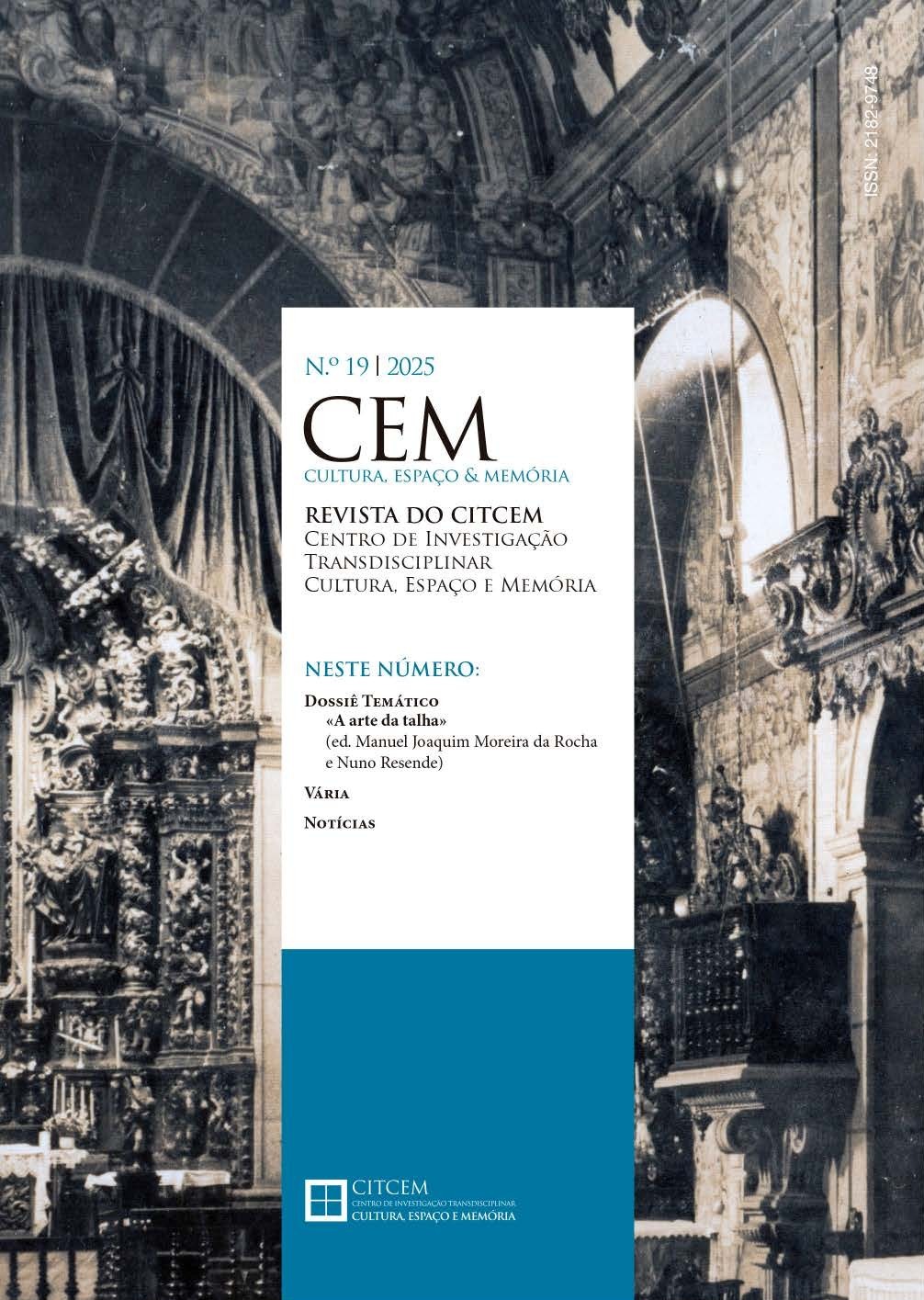
CEM
N.º 19 (2025): CEM
CEM N.º 19
CULTURA, ESPAÇO & MEMÓRIA
Direção: Inês Amorim
Edição do dossiê temático:
Manuel Joaquim Moreira da Rocha (U. Porto/FLUP-DCTP/CITCEM)
Nuno Resende (U. Porto/FLUP-DCTP/CITCEM)
A arte da talha
Num tempo em que a produção científica em ciências sociais e humanas se pauta, cada vez mais, por agendas externas e por tendências que privilegiam determinadas problemáticas contemporâneas, torna-se urgente refletir sobre domínios que, não se enquadrando nesses critérios de atualidade, vão sendo silenciados ou negligenciados. A situação é tanto mais grave quando se trata de áreas como o património cultural, campo em que a Universidade do Porto construiu, ao longo de décadas, uma reputada tradição de investigação científica, quer a nível nacional quer internacional.Independentemente das modas ou das métricas de avaliação, a relevância dos temas a investigar não pode ser quantificada de forma simplista. Nesse sentido, as artes da talha e da retabulística impõem-se como objeto de estudo incontornável, quer enquanto técnica artística quer como expressão patrimonial disseminada em contextos culturais muito diversos. A talha em madeira e os retábulos constituem teste-munhos materiais de grande riqueza artística, presentes em incontáveis espaços reli-giosos — sobretudo no mundo católico — mas também em contextos civis, em geografias que vão do sul da Europa, às Américas, da Índia ao Sri Lanka ou à Indonésia.Longe de se tratar de um fenómeno local ou meramente barroco, a talha atravessa épocas e geografias, agregando múltiplos saberes e ofícios — do entalhe à carpintaria, do douramento à pintura — num verdadeiro «corpo coletivo» de produção artística. Os retábulos, por sua vez, assumem-se como objetos artísticos integrados, onde confluem a arquitetura, a escultura, a pintura, a iconografia, a liturgia e até elementos senso -riais como a música e a acústica, projetos complexos concebidos e desenhados por artistas excecionais.A Faculdade de Letras da Universidade do Porto desempenhou um papel pioneiro no estudo destas manifestações, deixando uma marca historiográfica que importa revi-sitar. Retomar esse legado significa não só reconhecer os contributos do passado, mas também abrir caminhos a novas abordagens metodológicas e interdisciplinares. Estudar a retabulística, hoje, implica cruzar a análise da estrutura física e arquitetónica com o desenho artístico, com a linguagem plástica dos relevos, com os programas icono gráficos e com os contextos litúrgicos e performativos que lhe dão sentido.
Os trabalhos submetidos a este número são reveladores, por um lado, da impor-tância da continuidade dos estudos da talha e da retabulística e, por outro, da expansão dos mesmos a áreas afins, próximas ou mais distantes artística, técnica e tematicamente falando — revelando assim a riqueza de abordagens deste assunto:
• A investigação sobre a Capela de Nossa Senhora das Verdades documenta a sua reabilitação e destaca o retábulo no contexto da talha portuense.
• O estudo sobre o órgão do Convento de Santo Elói, no Porto, analisa as colabo-rações entre mestres de talha e de pintura, propondo a autoria da caixa do órgão com base em fontes contratuais.
• Uma reflexão sobre a efemeridade em arte assinala a relevância da prática dos armadores e da armação litúrgica nos séculos XIX e XX, cruzando fontes escritas e visuais, com destaque para o contexto portuense.
• A análise das ofertas devocionais oriundas da Terra Santa permite reconhecer a presença de objetos em madrepérola e em madeira de oliveira nos retábulos portugueses, revelando redes de circulação e piedade global.
• Uma investigação sobre o painel da Circuncisão, pertencente à diocese do Porto,relaciona a obra com a tipologia retabular e analisa o seu percurso institucional à luz da conservação e restauro.
• Um estudo centrado na Igreja de Tibães explora o papel do coro alto beneditino,valorizando os painéis esculpidos e a sua iconografia no contexto da renovação litúrgica pós-Trento.
• O trabalho sobre a produção de sanefas rocaille em Aveiro traça a atuação do mestre entalhador Manuel Ferreira e Sousa «filho», identificando núcleos e séries em diferentes instituições religiosas.
• A encomenda do altar da Sagrada Família nos Jerónimos é analisada a partir de um contrato de 1734, contextualizando a atuação do entalhador e o ambiente artístico lisboeta pré-terramoto.
• Por fim, destaca-se a originalidade do barroco português e a atuação de ManuelFerreira de Figueiredo em Penafiel, num exemplo de produção regional de grande sofisticação entre 1688 e 1702.
Estes trabalhos e respetivos propósitos investigativos articulam-se com as linhas orientadoras do plano estratégico do CITCEM — Centro de Investigação Transdis-ciplinar Cultura, Espaço e Memória —, que reconhece a importância do património como construção cultural dinamizada em diálogo com as comunidades. Ao valorizar o estudo da talha e dos retábulos enquanto património vivido, entendido não apenas como objeto histórico, mas como elemento identitário e agregador de memórias cole-tivas, este número da revista CEM contribui para uma investigação que se quer mais participada, plural e enraizada no território, tal como defendido pelo CITCEM.
Neste quadro, justifica-se plenamente a pertinência deste número da revista, que procura estimular contributos dedicados às artes da talha e do retábulo. Ao revisitar a herança académica da Universidade do Porto e propor novas problemáticas, este número visa reafirmar a importância de um campo de estudo essencial para a compreensão do património artístico e cultural.Resta-nos agradecer à Professora Doutora Inês Amorim a aceitação da nossa proposta temática e a toda a equipa da CEM pelo trabalho desenvolvido.Manuel Joaquim Moreira da RochaNuno Resende
Autores:
Direção: Inês Amorim Edição do dossiê temático: Manuel Joaquim Moreira da Rocha (U. Porto/FLUP-DCTP/CITCEM) Nuno Resende (U. Porto/FLUP-DCTP/CITCEM)
Editora:
CITCEM – Centro de Investigação Transdisciplinar Cultura, Espaço e Memória
ISSN:
2182-9748
ISBN:
Ano:
2025
Grupo de Investigação:
Sociabilidades e Práticas Religiosas
PUBLICAÇÕES
CEM
NO. 19 (2025): CEM
CEM NO. 19
CULTURE, SPACE & MEMORY
Direction: Inês Amorim
Issue of the thematic dossier:
Manuel Joaquim Moreira da Rocha (U. Porto/FLUP-DCTP/CITCEM)
Nuno Resende (U. Porto/FLUP-DCTP/CITCEM)
The art of carving
At a time when scientific production in the social sciences and humanities is increasingly guided by external agendas and trends that privilege certain contemporary issues, it is becoming urgent to reflect on areas that do not fit these current criteria and are being silenced or neglected. The situation is all the more serious when it comes to areas such as cultural heritage, a field in which the University of Porto has built up a reputable tradition of scientific research over the decades, both nationally and internationally.Regardless of fashions or evaluation metrics, the relevance of the topics to be researched cannot be quantified in a simplistic way. In this sense, the arts of carving and retabulism are an unavoidable object of study, both as an artistic technique and as an expression of heritage disseminated in very diverse cultural contexts. Wood carvings and altarpieces are material testimonies of great artistic richness, present in countless religious spaces – especially in the Catholic world – but also in civil contexts, in geographies ranging from southern Europe to the Americas, from India to Sri Lanka or Indonesia.Far from being a local or merely baroque phenomenon, woodcarving crosses eras and geographies, bringing together multiple skills and crafts – from carving to carpentry, from gilding to painting – in a true “collective body” of artistic production. The altarpieces, on the other hand, are integrated artistic objects, where architecture, sculpture, painting, iconography, liturgy and even sensory elements such as music and acoustics come together, complex projects conceived and designed by exceptional artists.The Faculty of Letters of the University of Porto played a pioneering role in the study of these manifestations, leaving a historiographical mark that should be revisited. Taking up this legacy means not only recognizing the contributions of the past, but also opening up new methodological and interdisciplinary approaches. Studying retabulism today implies crossing the analysis of the physical and architectural structure with artistic design, the plastic language of reliefs, iconographic programs and the liturgical and performative contexts that give it meaning.
The papers submitted to this issue show, on the one hand, the importance of continuing the study of woodcarving and retabulism and, on the other, its expansion into related areas, whether close or more distant artistically, technically and thematically speaking – thus revealing the wealth of approaches to this subject:
– The research on the Chapel of Our Lady of Truths documents its rehabilitation and highlights the altarpiece in the context of Porto woodcarving.
– The study on the organ of the Convent of Santo Elói in Porto analyzes the collaborations between carving and painting masters and proposes the authorship of the organ case based on contractual sources.
– A reflection on ephemerality in art points out the relevance of the practice of shipowners and liturgical frames in the 19th and 20th centuries, crossing written and visual sources, with an emphasis on the context of Porto.
– An analysis of devotional offerings from the Holy Land reveals the presence of mother-of-pearl and olive wood objects in Portuguese altarpieces, revealing networks of circulation and global piety.
– An investigation into the panel of the Circumcision, belonging to the diocese of Porto, relates the work to the altarpiece typology and analyzes its institutional journey in the light of conservation and restoration.
– A study centered on the Church of Tibães explores the role of the Benedictine high choir, valuing the sculpted panels and their iconography in the context of the post-Trent liturgical renewal.
– The work on the production of rocaille pelmets in Aveiro traces the work of the master carver Manuel Ferreira e Sousa “filho”, identifying nuclei and series in different religious institutions.
– The commission for the altar of the Holy Family in the Jerónimos is analyzed based on a contract from 1734, contextualizing the carver’s work and the artistic environment in Lisbon before the earthquake.
– Finally, we highlight the originality of the Portuguese Baroque and the work of Manuel Ferreira de Figueiredo in Penafiel, in an example of highly sophisticated regional production between 1688 and 1702.
These works and their respective research purposes are in line with the guidelines of the strategic plan of CITCEM – the Transdisciplinary Research Centre for Culture, Space and Memory – which recognizes the importance of heritage as a cultural construction that is promoted in dialogue with communities. By valuing the study of carvings and altarpieces as lived heritage, understood not only as a historical object, but as an identity element and aggregator of collective memories, this issue of CEM contributes to research that is more participatory, plural and rooted in the territory, as advocated by CITCEM.
In this context, the relevance of this issue of the journal, which seeks to stimulate contributions dedicated to the arts of woodcarving and altarpieces, is fully justified. By revisiting the academic heritage of the University of Porto and proposing new issues, this issue aims to reaffirm the importance of a field of study that is essential for understanding artistic and cultural heritage. We would like to thank Professor Inês Amorim for accepting our thematic proposal and the entire CEM team for their work.Manuel Joaquim Moreira da RochaNuno Resende
Autores:
Direção: Inês Amorim Edição do dossiê temático: Manuel Joaquim Moreira da Rocha (U. Porto/FLUP-DCTP/CITCEM) Nuno Resende (U. Porto/FLUP-DCTP/CITCEM)
Editora:
CITCEM – Centro de Investigação Transdisciplinar Cultura, Espaço e Memória
ISSN:
2182-9748
ISBN:
Ano:
2025
Grupo de Investigação:
Sociabilidades e Práticas Religiosas