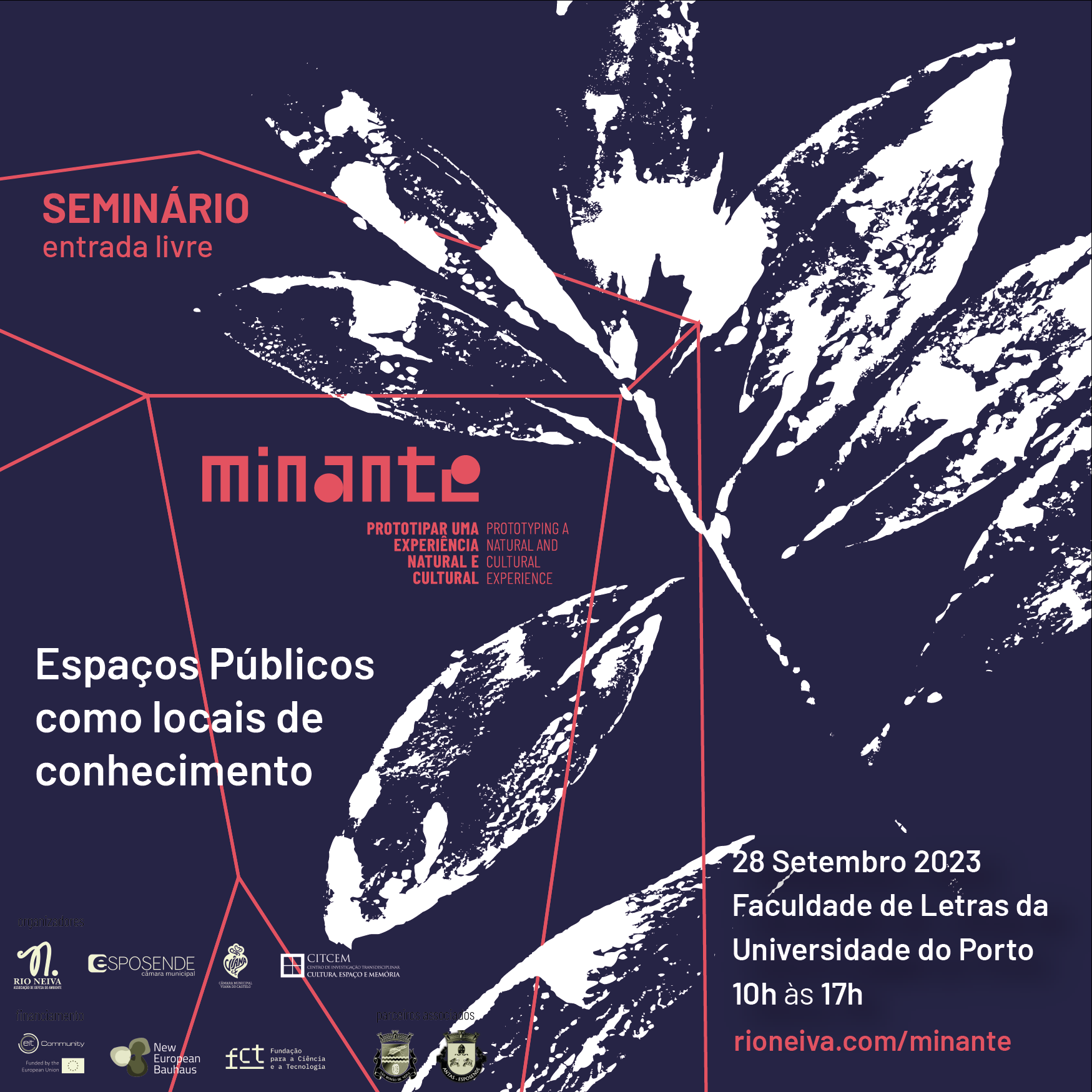
Public spaces as locus of knowledge: Prototyping a natural and cultural heritage experience through co-creation with the local community.
No dia 28 de setembro, a partir das 10, na FLUP, poderá participar no seminário “Public spaces as locus of knowledge: Prototyping a natural and cultural heritage experience through co-creation with the local community.”
Este seminário científico parte e decorre no âmbito do projeto em curso ‘Minante: Prototipar uma experiência natural e cultural para a co-criação do espaço público’, no rio Neiva, apoiado pela Nova Bauhaus Europeia.
Este evento é promovido pelo CITCEM – Centro de Investigação Transdisciplinar Cultura, Espaço e Memória, enquanto parceiro do projeto, e destina-se à investigadores e profissionais que trabalhem sobre o tema e orientações temáticas mais abrangentes.
Tem como objetivo promover um debate científico enquadrado na relação entre criação de conhecimento, espaços públicos, participação comunitária e sustentabilidade.
Orientações temáticas: Co-conceção do espaço público, Intervenções no espaço público, Memórias e histórias locais, co-criação e ciência cidadã como metodologias.
Public spaces as locus of knowledge: Prototyping a natural and cultural heritage experience through co-creation with the local community.
On September 28, starting at 10 a.m., at FLUP, you can take part in the seminar “Public spaces as locus of knowledge: Prototyping a natural and cultural heritage experience through co-creation with the local community.”
This scientific seminar is part of the ongoing project ‘Minante: Prototyping a natural and cultural experience for the co-creation of public space’ on the Neiva River, supported by the New European Bauhaus.
This event is promoted by CITCEM – Center for Transdisciplinary Research on Culture, Space and Memory, as a partner in the project, and is aimed at researchers and professionals working on the topic and broader thematic orientations.
Its aim is to promote a scientific debate on the relationship between knowledge creation, public spaces, community participation and sustainability.
Thematic orientations: Co-conception of public space, Interventions in public space, Local memories and histories, co-creation and citizen science as methodologies.