
EVENTOS
Local:
FLUP - Anfiteatro Nobre
Data início:
19/02/2025
Data fim:
19/02/2025
Horário:
Organização:
CITCEM e IF
Grupo de Investigação Associado
Sociabilidades e Práticas Religiosas
Tipo de Evento:
Colóquio
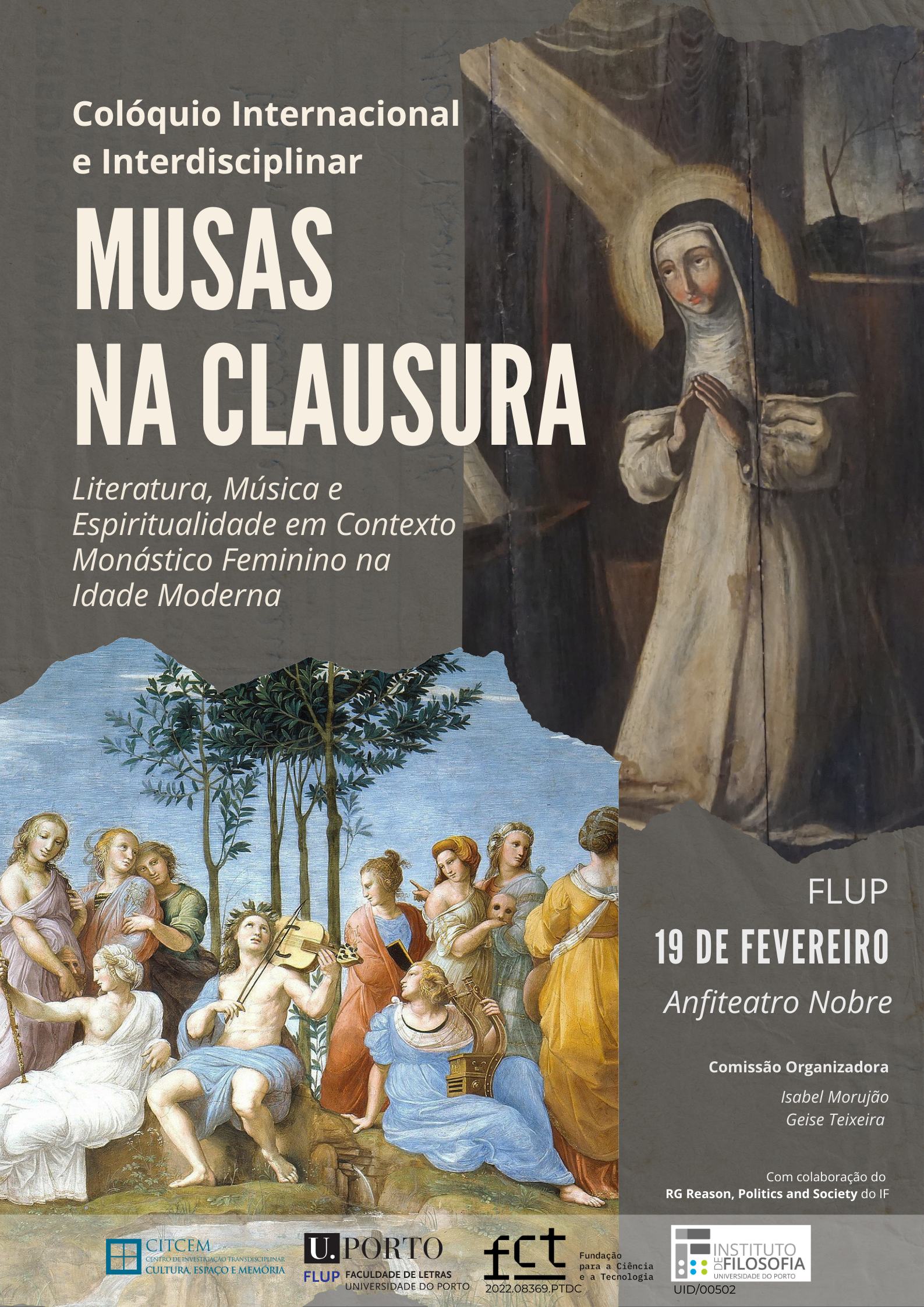
Musas na Clausura
No âmbito do Projeto MOISTER decorrerá o Colóquio Internacional e Interdisciplinar MUSAS NA CLAUSURA: Literatura, Música e Espiritualidade em Contexto Monástico Feminino na Idade Moderna.
A entrada é livre!
19 DE FEVEREIRO
Faculdade de Letras da Universidade do Porto – Anfiteatro Nobre
09h30 – Abertura
10h00 – 11h30 | Sessão 1
María Martos Pérez (UNED/BIESES) – Mecanismos de enunciación en la poesía de sor Violante do Céu.
Clara Barros (U. Porto/CLUP) – Tradições textuais nos mosteiros femininos na Idade Moderna: o discurso da monja dominicana Soror Violante do Céu.
Antía Tacón (Univ. Santiago de Compostela) – “Venham todos os pastores / de Castela, e Portugal”: quatro vilancicos bilingues de Violante do Céu.
Ana Reis (CITCEM) – Redes de sociabilidade de Soror Violante do Céu, na poesia de Parnaso Lusitano.
11h30 – 11h45 | Pausa para café
11h45 – 12h45 | Sessão 2
Rogelio Ponce de Léon (U. Porto/CLUP) e Pedro Dono López (U. Minho/CEHUM) – Editando a Violante do Céu. Consideraciones al hilo de una propuesta editorial sobre poemas en castellano.
Verònica Zaragoza Gómez (Universitat de València/BIESES) – O cancioneiro poético de Sor Eufrasia Teixidor (1712-1767): uma voz poética feminina na interseção entre a expressão lírica e o discurso confessional.
13h00 – 14h15 | Almoço
14h30 – 15h45 | Sessão 3
Magna Ferreira (ESMAE/IPP) e Pedro Castro (ESML/IPL) – A música nos conventos femininos: contributo para o entendimento da práxis musical no quotidiano de Soror Violante do Céu.
Mercè Gras Casanova (Arxiu dels Carmelites Descalços de Catalunya i Balears ) – A prática musical nos mosteiros dominicos de Cataluña e Valência: formação, criação e difusão.
Inês de Sá (FBK-ISIG) – “Nasciendo muger, pareces Diosa”. O amor e a figura feminina no teatro de religiosas portuguesas da primeira metade do século XVIII.
15h45 – 16h00 | Pausa para café
16h00 – 17h30 | Sessão 4
Micaela Ramon (U. Minho/CEHUM) – “Com tanta erudição, com valor tanto”. Saber e virtude na poesia de Soror Violante do Céu.
Geise Teixeira (IPB/CITCEM) – “Murió para vivir eternamente”. Morte e Imortalidade na poesia fúnebre de Soror Violante do Céu.
Isabel Morujão (U. Porto/CITCEM) – O cancioneiro poético de Violante do Céu: texto e intertexto.
17h30 – Encerramento
Ingressar na reunião Zoom https://videoconf-colibri.zoom.us/j/93880681744?pwd=VzXTE8atnBq9xDhQETunHfa0YVZwMi.1
ID da reunião: 938 8068 1744
Senha: 288852
CURRICULUM VITAE DOS CONFERENCISTAS
SESSÃO 1
María Martos Pérez
María Martos Pérez é Professora Titular na Universidad Nacional de Educación a Distancia (UNED), Madrid. É investigadora em Literatura Espanhola da Idade Moderna, com foco na literatura dos séculos XVI e XVII e na recuperação de autores e obras. Integra a equipa de investigação do projeto BIESES desde 2011 e lidera o grupo como Investigadora Principal desde 2018. Foi investigadora visitante na Università degli Studi di Pavia, Brown University e El Colegio de México. Participa em redes científicas como AISO, GEMELA e Renaissance Society of America. Coedita a Revista de Escritoras Ibéricas e coordena o Seminário Permanente “Literatura e Mulheres” da UNED. Entre as suas publicações, destacam-se estudos sobre autoria feminina e sua expressão textual, como The poetic voice (2017) e La voz poética de María Gertrudis Hore (2022). Além da literatura feminina, investiga o Teatro do Século de Ouro e a sua receção na literatura contemporânea.
É investigadora do projeto MOISTER – Musas na clausura. A obra poética de Violante do Céu: espiritualidade, literatura e música no Mosteiro da Rosa de Lisboa, financiado pela FCT.
Clara Barros
Clara Barros é Professora Associada da Faculdade de Letras da Universidade do Porto e investigadora no Centro de Linguística da Universidade do Porto (CLUP), onde coordena, desde 2024, a linha de investigação em Linguística Histórica. Também é membro colaborador do Centro de Estudos de Linguística Geral e Aplicada (CELGA), integrando a linha temática “História da Língua Portuguesa e História da Consciência Linguística” desde 2008. Doutora em Linguística pela FLUP, as suas áreas de investigação incluem Pragmática Histórica, teoria das tradições discursivas e História da Língua Portuguesa. Publicou diversos artigos e capítulos sobre esses temas em revistas e coletâneas nacionais e internacionais.
É investigadora do projeto MOISTER – Musas na clausura. A obra poética de Violante do Céu: espiritualidade, literatura e música no Mosteiro da Rosa de Lisboa, financiado pela FCT.
Ana Reis
Ana Reis é licenciada em Línguas e Literaturas Modernas – Português/Inglês, mestre em Estudos Literários, Culturais e Interartes – Literatura Portuguesa, com a dissertação Reino de Babilónia, de Soror Madalena da Glória: Textos e paratextos (reedição e leitura) e doutorada em Estudos Literários, Culturais e Interartísticos (FLUP), com a dissertação A literatura monástica feminina no circuito editorial: Paratextos e redes. Colaborou na edição de Memorial dos Milagres de Cristo, de Soror Maria de Mesquita Pimentel, na edição de Memorial da Paixão, da mesma autora (em revisão) e atualmente é investigadora do Projeto MOISTER – Musas na clausura. A obra poética de Violante do Céu: espiritualidade, literatura e música no Mosteiro da Rosa de Lisboa.
SESSÃO 2
Rogelio Ponce Leon
Rogelio Ponce de León Romeo é Professor Associado da Faculdade de Letras da Universidade do Porto, onde leciona nas áreas de historiografia gramatical, didática do espanhol como língua estrangeira e tradução espanhol-português. É licenciado em Filologia Clássica pela Universidade Complutense de Madrid (1991) e doutor em Filologia na mesma Universidade (2001). É autor de mais de uma centena de estudos sobre historiografia linguística na Península Ibérica, história do ensino do espanhol em Portugal e do português em Espanha, didática do espanhol como língua estrangeira e pragmática contrastiva português-espanhol.
É vice-coordenador do projeto MOISTER.
Pedro Dono López
Pedro Dono López é professor auxiliar do Departamento de Estudos Românicos na Escola de Letras, Artes e Ciências Humanas da Universidade do Minho. Anteriormente exerceu como docente de língua e cultura galegas no Centro de Estudos Galegos na mesma Universidade. Foi Diretor do Departamento de Estudos Românicos e desde o ano de 2018 dirige o Mestrado em Espanhol como Língua Segunda e Língua Estrangeira. Os seus interesses de investigação prendem-se com a ecdótica, a linguística histórica e a didática de LE/L2.
É investigador do projeto MOISTER.
Verònica Zaragoza
Verònica Zaragoza Gómez é investigadora do grupo BIESES (Bibliografía de Escritoras Españolas) da UNED. É professora na Universidade de Valência, onde leciona Teoria da Literatura e Estudos Culturais. É licenciada em Filologia Catalã pela Universidade de Valência e Doutora pela Universidade de Girona, com uma tese sobre poesia de autoria feminina na Idade Moderna, que lhe mereceu o prémio extraordinário de doutoramento.
Tem centrado a sua carreira de investigação na recuperação e estudo dos inéditos de autoria feminina, procedentes sobretudo de arquivos de conventos e mosteiros femininos. Além do resgate e análise de obras de autoras carmelitanas ou dominicanas, outras das suas linhas de Investigação são as contribuições das mulheres da célebre família papal dos Borja, a implicação das mulheres na esfera festiva barroca e nos certames poéticos urbanos entendidos como espaços e mecanismos de agência política e cultural por parte das mulheres participantes, ou a relação de algumas figuras religiosas com a inquisição por motivos de heterodoxia ou falsa santidade. Recentemente, acaba de publicar o livro Les dones Borja. Historias de poder e protagonismo oculto (2022) e o volume coletivo Encerradas. Mujer, escritura y reclusión (2022,) coeditado con Purificació Mascarell.
Antía Tacón
Antía Tacón é investigadora de pós-doutoramento na Universidade de Santiago de Compostela. Obteve o título de Doutora em Estudos da Literatura e da Cultura (2023, menção internacional cum laude) pela mesma Universidade, com a tese intitulada “Dramaturgas do séc. XVII: estudo das personagens da comédia nova”. Tem publicado diversos artigos e capítulos de livro sobre as escritoras da Idade Moderna. Atualmente, desenvolve o projeto “Literatura em castelhano nos conventos femininos portugueses (séculos XVII-XVIII): sociabilidade literária e interseções culturais ibéricas”, com financiamento da Xunta de Galicia (ED481B_032).
SESSÃO 3
Magna Ferreira
Magna Ferreira é docente no Curso de Música Antiga da Escola Superior de Música e Artes do Espetáculo (Instituto Politécnico do Porto) e no Conservatório de Música do Porto. É Licenciada em Canto pela ESMAE, Mestre em Educação Musical pela Universidade do Minho e Mestre em Advanced Vocal Ensemble Studies pela Schola Cantorum Basiliensis (Suíça). É Doutorada em Musicologia pela Faculdade de História da Universidade de Santiago de Compostela e investigadora colaboradora do Centro de Investigação Transdisciplinar «Cultura, Espaço e Memória» (CITCEM) da Faculdade de Letras da Universidade do Porto.
Foi membro do Estúdio de Ópera da Casa da Música. Como solista, apresentou-se em Portugal, Espanha, França, Itália, Suíça, Polónia, México, Angola e Brasil.
Enquanto maestrina, integrou a equipa artística da Área da Comunidade em Guimarães Capital da Cultura, foi diretora do projeto “Vozes do Românico” e dirigiu a Orquestra Barroca da ESMAE em óperas de Haendel, Purcell e Monteverdi. Dirigiu diversos grupos corais e orquestrais e gravou a estreia de obras de compositores portugueses.
Colaborou com o Serviço Educativo da Casa da Música e trabalhou como formadora com o Teatro Nacional de S. João, o Centre Culturel de Rencontre Ambronay, a Universidade do Minho, a Universidade Lusófona, entre outros. Gravou para a Antena 2, RTP, Challenge Classics, Au Fil de l’air, entre outros.
Lecionou masterclasses de Canto (Música Antiga) e de música vocal de conjunto em Angola, Brasil, Espanha, França e Itália. Atualmente, dedica-se à investigação do repertório conventual feminino português no Antigo Regime. Neste contexto, fundou e dirige o grupo de música antiga “Metáfora das Flores”. É investigadora do Projeto MOISTER, financiado pela FCT.
Mercè Gras Casanova
Historiadora da Idade Moderna, é especialista em arquivos conventuais e, desde 1998, é arquivista do Arquivo dos carmelitas descalços de Catalunha e Baleares. Integrou diversos projetos de Investigação e publicou vários livros e mais de uma centena de artigos sobre a cultura conventual. Comissariou diversas exposições.
É responsável pela web castellinterior.com, um repositório de bibliografia, documentação e artigos relativos ao Carmelo descalço. Nos últimos anos, contribuiu com diversas aportações para a compreensão da literatura e da música nas festividades conventuais femininas. Está atualmente a completar um repertório de vilancicos e oratórios musicais femininos e, juntamente com Verònica Zaragoza, trabalha na edição de cancioneiros conventuais do Carmelo descalço feminino da Coroa de Aragão (sécs. XVII-XIX).
Inês de Sá
Inês de Sá é mestre em História pela Faculdade de Ciências Sociais e Humanas da Universidade Nova de Lisboa (FCSH-UNL). Na sua dissertação, intitulada “«Del mundo preza, y del Amor Herida». O amor no teatro escrito por mulheres em Portugal (ca.1650-1750)”, debruçou-se sobre o mundo cultural e teatral nos mosteiros femininos e a relação das conceções de amor com a condição feminina durante a Época Moderna.
Atualmente, trabalha no Istituto Storico Italo-Germanico (FBK-ISIG), no projeto Holylab, que estuda a circulação de dinheiro e objetos na Custódia Franciscana de Jerusalém durante o período moderno.
SESSÃO 4
Micaela Ramon
Micaela Ramon é docente do DEPL-ELACH, Univ.do Minho, onde leciona Literatura Portuguesa e Português como Língua Estrangeira em cursos de graduação, pós-graduação e extensão. É doutora em Literatura Portuguesa, investigadora integrada do Centro de Estudos Humanísticos (CEHUM) e investigadora colaboradora no Centro de Estudos Globais da Universidade Aberta (CEG-UAb). É diretora do Mestrado em Português Língua Não Materna e vogal da direção do BabeliUM – Centro de Línguas da Universidade do Minho, com o pelouro do Português Língua Estrangeira (PLE). É autora de livros, capítulos e artigos em revistas e atas de encontros científicos, nacionais e internacionais, sobre temas ligados às áreas que investiga e leciona.
É investigadora do Projeto MOISTER, financiado pela FCT.
Geise Teixeira
Geise Teixeira é doutora em Estudos Literários, Culturais e Interartísticos pela Faculdade de Letras da Universidade do Porto. Atualmente, é professora adjunta convidada de Literatura e Cultura na Escola Superior de Educação do Instituto Politécnico de Bragança e investigadora integrada do Centro de Investigação Transdisciplinar “Cultura, Espaço e Memória” (CITCEM). Exerceu funções como professora visitante na Universidade do Estado do Rio Grande do Norte e integrou, como investigadora contratada, a equipa do projeto MOISTER – “Musas na Clausura: a obra poética de Violante do Céu: Literatura, música e espiritualidade no Mosteiro da Rosa de Lisboa”, financiado pela FCT. Os seus principais interesses científicos centram-se na literatura portuguesa dos séculos XVI-XVIII, especificamente na literatura conventual feminina.
Fr. António de S. José d’Almeida
O Pe. Fr. António de S. José d’Almeida é doutor em História da Arte pela Universidade do Porto, sendo especialista em Iconografia Cristã. Professo da Ordem dos Pregadores, é atualmente membro do Convento de Cristo Rei, no Porto. Académico de Mérito da Academia Portuguesa da História, é autor de múltiplas publicações, das quais se destacam alguns artigos sobre Mosteiros femininos da Ordem dos Pregadores em Portugal.
Isabel Morujão
Isabel Morujão é Professora Associada da Faculdade de Letras da Universidade do Porto, sua Alma Mater, onde se doutorou em 2005 em Literatura Portuguesa, com a tese Por trás da grade. Poesia Monástica Feminina em Portugal – sécs. XVI-XVIII , editada pela Imprensa Nacional- Casa da Moeda.
A sua área preferencial de investigação é a literatura feminina dos sécs XVI-XVIII, nas suas várias tipologias e manifestações. Interessa-se ainda pela espiritualidade feminina (mística e ascética) da Idade Moderna e pela História do Teatro Português entre os séculos XVI a XVIII. Autora de mais de uma centena de publicações, tem desenvolvido e incentivado trabalhos de edição de manuscritos e reedição de livros dos séculos XVII e XVIII, no âmbito de um interesse mais vasto pela história do livro e da leitura em Portugal na Época Moderna.
Atualmente, é Coordenadora do PROJETO MOISTER – “Musas na Clausura: a obra poética de Violante do Céu: Literatura, música e espiritualidade no Mosteiro da Rosa de Lisboa”, financiado pela FCT.
EVENTOS
Local:
FLUP - Anfiteatro Nobre
Data início:
19/02/2025
Data fim:
19/02/2025
Horário:
Organização:
CITCEM e IF
Grupo de Investigação Associado
Sociabilidades e Práticas Religiosas
Tipo de Evento:
Colloquium
Muses in the Clausura
As part of the MOISTER Project, the International and Interdisciplinary Colloquium MUSAS NA CLAUSURA: Literature, Music and Spirituality in a Female Monastic Context in the Modern Age will take place.
Admission is free!
FEBRUARY 19TH
Faculty of Arts and Humanities of the University of Porto – Noble Amphitheater
09:30 – Opening
10h00 – 11h30 | Session 1
María Martos Pérez (UNED/BIESES) – Mecanismos de enunciación en la poesía de sor Violante do Céu.
Clara Barros (U. Porto/CLUP) – Textual traditions in women’s monasteries in the Modern Age: the discourse of the Dominican nun Soror Violante do Céu.
Antía Tacón (Univ. Santiago de Compostela) – “Venham todos os pastores / de Castela, e Portugal”: quatro vilancicos bilingues de Violante do Céu.
Ana Reis (CITCEM) – Soror Violante do Céu’s networks of sociability in the poetry of Parnaso Lusitano.
11:30 – 11:45 | Coffee break
11h45 – 12h45 | Session 2
Rogelio Ponce de Léon (U. Porto/CLUP) and Pedro Dono López (U. Minho/CEHUM) – Editing Violante do Céu. Consideraciones al hilo de una propuesta editorial sobre poemas en castellano.
Verònica Zaragoza Gómez (Universitat de València/BIESES) – Sor Eufrasia Teixidor’s poetic songbook (1712-1767): a female poetic voice at the intersection between lyrical expression and confessional discourse.
13h00 – 14h15 | Lunch
14h30 – 15h45 | Session 3
Magna Ferreira (ESMAE/IPP) and Pedro Castro (ESML/IPL) – Music in women’s convents: a contribution to understanding the musical praxis in the daily life of Soror Violante do Céu.
Mercè Gras Casanova (Arxiu dels Carmelites Descalços de Catalunya i Balears ) – Musical practice in the Dominican monasteries of Catalonia and Valencia: formation, creation and dissemination.
Inês de Sá (FBK-ISIG) – “Nasciendo muger, pareces Diosa”. Love and the female figure in the theater of Portuguese nuns from the first half of the 18th century.
15h45 – 16h00 | Coffee break
16h00 – 17h30 | Session 4
Micaela Ramon (U. Minho/CEHUM) – “With so much erudition, with so much value”. Knowledge and virtue in the poetry of Soror Violante do Céu.
Geise Teixeira (IPB/CITCEM) – “Murió para vivir eternamente”. Death and Immortality in the funeral poetry of Soror Violante do Céu.
Isabel Morujão (U. Porto/CITCEM) – Violante do Céu’s poetic songbook: text and intertext.
17:30 – Closing
Join the Zoom meeting https://videoconf-colibri.zoom.us/j/93880681744?pwd=VzXTE8atnBq9xDhQETunHfa0YVZwMi.1
Meeting ID: 938 8068 1744
Password: 288852
SPEAKERS’ CURRICULUM VITAE
SESSION 1
María Martos Pérez
María Martos Pérez is a Full Professor at the Universidad Nacional de Educación a Distancia (UNED), Madrid. She is a researcher in Modern Spanish Literature, focusing on 16th and 17th century literature and the recovery of authors and works. She has been a member of the research team of the BIESES project since 2011 and has led the group as Principal Investigator since 2018. She has been a visiting researcher at the Università degli Studi di Pavia, Brown University and El Colegio de México. She participates in scientific networks such as AISO, GEMELA and Renaissance Society of America. She co-edits the Journal of Iberian Women Writers and coordinates the Permanent Seminar “Literature and Women” at UNED. Her publications include studies on female authorship and its textual expression, such as The poetic voice (2017) and La voz poética de María Gertrudis Hore (2022). In addition to women’s literature, she researches Golden Age theater and its reception in contemporary literature.
She is a researcher on the MOISTER project – Muses in the cloister. The poetic work of Violante do Céu: spirituality, literature and music at the Monastery of the Rose in Lisbon, funded by FCT.
Clara Barros
Clara Barros is an Associate Professor at the Faculty of Arts and Humanities of the University of Porto and a researcher at the Linguistics Center of the University of Porto (CLUP), where she has been coordinating the Historical Linguistics research line since 2024. She has also been a collaborating member of the Center for General and Applied Linguistics Studies (CELGA), integrating the thematic line “History of the Portuguese Language and History of Linguistic Consciousness” since 2008. She has a PhD in Linguistics from FLUP and her research areas include Historical Pragmatics, the theory of discursive traditions and the History of the Portuguese Language. She has published several articles and chapters on these topics in national and international journals and collections.
She is a researcher on the MOISTER project – Muses in the cloister. The poetic work of Violante do Céu: spirituality, literature and music at the Monastery of the Rose in Lisbon, funded by FCT.
Ana Reis
Ana Reis has a degree in Modern Languages and Literatures – Portuguese/English, a master’s degree in Literary, Cultural and Interart Studies – Portuguese Literature, with the dissertation Reino de Babilónia, by Soror Madalena da Glória: Textos e paratextos (reedição e leitura) and a PhD in Literary, Cultural and Interart Studies (FLUP), with the dissertation A literatura monástica feminina no circuito editorial: Paratextos e redes. She collaborated on the edition of Memorial dos Milagres de Cristo, by Soror Maria de Mesquita Pimentel, on the edition of Memorial da Paixão, by the same author (under revision) and is currently a researcher on the MOISTER Project – Muses in the cloister. The poetic work of Violante do Céu: spirituality, literature and music in the Monastery of the Rose in Lisbon.
SESSION 2
Rogelio Ponce Leon
Rogelio Ponce de León Romeo is an Associate Professor at the Faculty of Arts and Humanities of the University of Porto, where he teaches grammatical historiography, didactics of Spanish as a foreign language and Spanish-Portuguese translation. He has a degree in Classical Philology from the Complutense University of Madrid (1991) and a PhD in Philology from the same university (2001). He is the author of more than a hundred studies on linguistic historiography in the Iberian Peninsula, the history of teaching Spanish in Portugal and Portuguese in Spain, didactics of Spanish as a foreign language and Portuguese-Spanish contrastive pragmatics.
He is deputy coordinator of the MOISTER project.
Pedro Dono López
Pedro Dono López is an assistant professor in the Department of Romance Studies at the School of Letters, Arts and Human Sciences at the University of Minho. He previously taught Galician language and culture at the Center for Galician Studies at the same university. He was Director of the Department of Romance Studies and since 2018 has been directing the Master’s Degree in Spanish as a Second and Foreign Language. His research interests relate to ecdotics, historical linguistics and LE/L2 didactics.
He is a researcher on the MOISTER project.
Verònica Zaragoza
Verònica Zaragoza Gómez is a researcher in the BIESES group (Bibliography of Spanish Women Writers) at UNED. She is a lecturer at the University of Valencia, where she teaches Literature Theory and Cultural Studies. She has a degree in Catalan Philology from the University of Valencia and a PhD from the University of Girona, with a thesis on poetry by women in the Modern Age, which won her the extraordinary doctoral prize.
She has focused her research career on the recovery and study of unpublished works by women, mainly from the archives of female convents and monasteries. In addition to the recovery and analysis of works by Carmelite and Dominican women authors, other lines of research include the contributions of the women of the famous papal family of the Borjas, the involvement of women in the Baroque festive sphere and in urban poetic contests understood as spaces and mechanisms of political and cultural agency on the part of the participating women, or the relationship of some religious figures with the Inquisition for reasons of heterodoxy or false sanctity. She has recently published the book Les dones Borja. Histories of power and hidden protagonism (2022) and the collective volume Closed. Women, writing and imprisonment (2022,) coedited with Purificació Mascarell.
Antía Tacón
Antía Tacón is a post-doctoral researcher at the University of Santiago de Compostela. She obtained her PhD in Literature and Culture Studies (2023, international cum laude) from the same university, with a thesis entitled “Women playwrights of the 17th century: a study of the characters in the comedia nova”. She has published several articles and book chapters on women writers of the Modern Age. She is currently working on the project “Literature in Spanish in Portuguese women’s convents (17th-18th centuries): literary sociability and Iberian cultural intersections”, with funding from the Xunta de Galicia (ED481B_032).
SESSION 3
Magna Ferreira
Magna Ferreira is a lecturer on the Early Music Course at the Escola Superior de Música e Artes do Espetáculo (Porto Polytechnic Institute) and at the Porto Conservatory of Music. She has a degree in Singing from ESMAE, a Master’s degree in Music Education from the University of Minho and a Master’s degree in Advanced Vocal Ensemble Studies from Schola Cantorum Basiliensis (Switzerland). She has a PhD in Musicology from the Faculty of History of the University of Santiago de Compostela and is a collaborating researcher at the Transdisciplinary Research Center “Culture, Space and Memory” (CITCEM) of the Faculty of Arts and Humanities of the University of Porto.
She was a member of the Casa da Música Opera Studio. As a soloist, she has performed in Portugal, Spain, France, Italy, Switzerland, Poland, Mexico, Angola and Brazil.
As a conductor, she was part of the artistic team of the Community Area in Guimarães Capital of Culture, was director of the “Voices of the Romanesque” project and conducted the ESMAE Baroque Orchestra in operas by Haendel, Purcell and Monteverdi. She has directed various choral and orchestral groups and recorded the premieres of works by Portuguese composers.
She has collaborated with the Casa da Música Education Service and worked as a trainer with the Teatro Nacional de S. João, the Centre Culturel de Rencontre Ambronay, the University of Minho and the Lusófona University, among others. She has recorded for Antena 2, RTP, Challenge Classics, Au Fil de l’air, among others.
She has taught masterclasses in singing (Early Music) and ensemble vocal music in Angola, Brazil, Spain, France and Italy. She is currently researching the Portuguese female convent repertoire of the Ancien Régime. In this context, she founded and directs the early music group “Metáfora das Flores”. She is a researcher on the MOISTER Project, funded by FCT.
Mercè Gras Casanova
A historian of the Modern Age, she specializes in convent archives and has been the archivist of the Archives of the Discalced Carmelites of Catalonia and the Balearic Islands since 1998. She has been part of various research projects and has published several books and over a hundred articles on convent culture. She has curated several exhibitions.
She is responsible for the castellinterior.com website, a repository of bibliography, documentation and articles on the Barefoot Carmel. In recent years, she has made several contributions to the understanding of literature and music in women’s convent festivities. She is currently completing a repertoire of women’s vilancicos and musical oratorios and, together with Verònica Zaragoza, is working on the edition of conventual songbooks of the women’s Discalced Carmel of the Crown of Aragon (17th-19th centuries).
Inês de Sá
Inês de Sá has a master’s degree in History from the Faculty of Social and Human Sciences of the New University of Lisbon (FCSH-UNL). In her dissertation, entitled “Del mundo preza, y del Amor Herida”. O amor no teatro escrito por mulheres em Portugal (ca.1650-1750)”, she focused on the cultural and theatrical world in women’s monasteries and the relationship between conceptions of love and the status of women during the Modern Period.
He is currently working at the Italian-German Historical Institute (FBK-ISIG) on the Holylab project, which studies the circulation of money and objects in the Franciscan Custody of Jerusalem during the modern period.
SESSION 4
Micaela Ramon
Micaela Ramon is a lecturer at DEPL-ELACH, University of Minho, where she teaches Portuguese Literature and Portuguese as a Foreign Language in undergraduate, postgraduate and extension courses. She has a PhD in Portuguese Literature, is an integrated researcher at the Center for Humanistic Studies (CEHUM) and a collaborating researcher at the Center for Global Studies at Universidade Aberta (CEG-UAb). She is the director of the Master’s in Portuguese as a Non-Mother Tongue and a member of the board of BabeliUM – Language Center of the University of Minho, with responsibility for Portuguese as a Foreign Language (PLE). She is the author of books, chapters and articles in journals and proceedings of national and international scientific meetings on topics related to the areas she researches and teaches.
She is a researcher on the MOISTER Project, funded by FCT.
Geise Teixeira
Geise Teixeira holds a PhD in Literary, Cultural and Interartistic Studies from the Faculty of Arts and Humanities of the University of Porto. She is currently a guest lecturer in Literature and Culture at the School of Education of the Polytechnic Institute of Bragança and an integrated researcher at the Transdisciplinary Research Center “Culture, Space and Memory” (CITCEM). She has worked as a visiting professor at the State University of Rio Grande do Norte and was a contract researcher on the MOISTER project team – “Muses in Cloister: the poetic work of Violante do Céu: Literature, music and spirituality in the Monastery of the Rose in Lisbon”, funded by FCT. Her main scientific interests focus on Portuguese literature from the 16th-18th centuries, specifically on conventual women’s literature.
Friar António de S. José d’Almeida
Fr. António de S. José d’Almeida holds a doctorate in Art History from the University of Porto, specializing in Christian Iconography. A professed member of the Order of Preachers, he is currently a member of the Convent of Christ the King in Porto. An Academician of Merit of the Portuguese Academy of History, he is the author of many publications, including articles on the female monasteries of the Order of Preachers in Portugal.
Isabel Morujão
Isabel Morujão is an Associate Professor at the Faculty of Arts and Humanities of the University of Porto, her Alma Mater, where she received her PhD in 2005 in Portuguese Literature, with the thesis Behind the Grid. Women’s Monastic Poetry in Portugal – 16th-18th centuries published by the Portuguese Mint and Official Printing Office.
Her main area of research is women’s literature from the 16th-18th centuries, in its various types and manifestations. She is also interested in female spirituality (mysticism and asceticism) in the Modern Age and the History of Portuguese Theater between the 16th and 18th centuries. The author of more than a hundred publications, she has developed and encouraged work on editing manuscripts and re-editing books from the 17th and 18th centuries, as part of a wider interest in the history of books and reading in Portugal in the Modern Period.
She is currently coordinator of the MOISTER PROJECT – “Muses in Cloister: the poetic work of Violante do Céu: Literature, music and spirituality in the Monastery of the Rose in Lisbon”, funded by FCT.