Local:
Data início:
Data fim:
Horário:
Organização:
Grupo de Investigação Associado
Tipo de Evento:
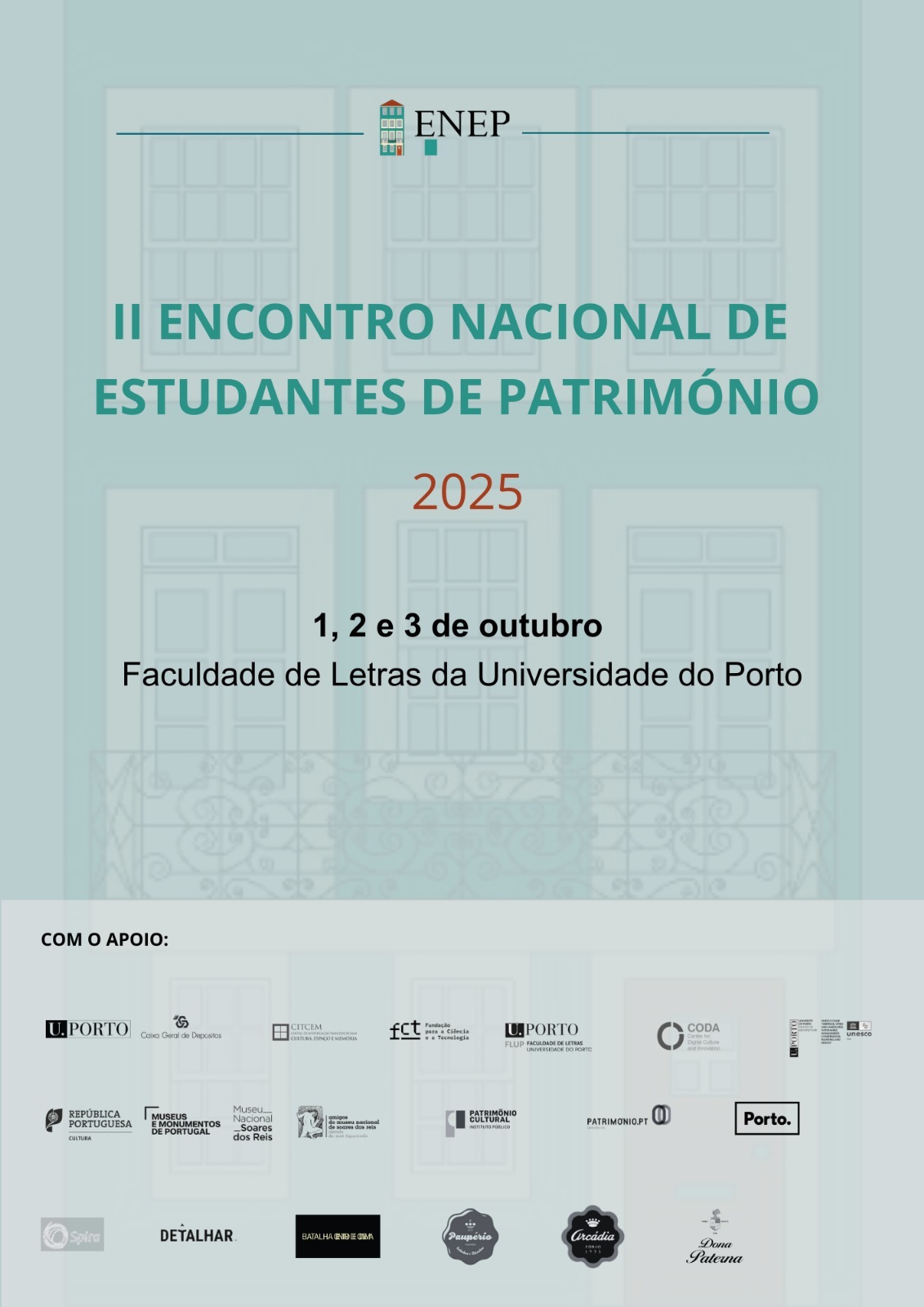
Encontro Nacional de Estudantes do Património 2025
De Estudantes. Para Estudantes.
Vamos repensar o Património no Séc.XXI
1, 2 e 3 de outubro
Faculdade de Letras da Universidade do Porto, Porto
O património é uma herança viva, pelo que depende do seu contínuo reconhecimento e valorização, os quais ditarão a sua permanência, ressignificação ou perda. Ao longo do tempo, a própria acessão de património vai sofrendo alterações, passando do monumento enquanto elemento portador de memória e do bem que é legado entre gerações, contribuindo para preservar identidades e heranças culturais, até à inclusão de diversas categorias patrimoniais que testemunham a diversidade cultural e a ação humana num determinado contexto.
Assim, deparámos enquanto paradigmas com o surgimento de novos patrimónios e a ressignificação/reutilização de antigos, levando-nos a indagar acerca do que é e do que poderá ser património (o complexo de Noé apontado por Françoise Choay) e como é que o devemos abordar. Note-se que, por vezes, a conservação do património passa pela atribuição de novos usos, devendo-se para tal adaptar os bens a novas realidades e hábitos, atendendo igualmente à premência da sustentabilidade e à resposta a problemas como a gentrificação, turistificação, totemismo (fetichismo patrimonial) e o fachadismo. Por outro lado, somos alertados para a democratização cultural, estabelecendo-se novas pontes entre o património e as comunidades, novas formas de comunicar e novos discursos patrimoniais. Ainda, releva-se o património digital enquanto categoria emergente, convocando para o debate os meios para a sua salvaguarda e o lugar da inteligência artificial no património, conduzindo igualmente para o questionamento sobre a virtualização patrimonial.
Por este motivo, convidam-se os interessados a repensar o património no século XXI, através da partilha conjunta de diferentes perspetivas. Neste sentido, desafia-se a apresentação de propostas enquadradas em três áreas temáticas:
- Novos usos do património
- Democratização do património
- Património Digital

Local:
Data início:
Data fim:
Horário:
Organização:
Grupo de Investigação Associado
Tipo de Evento:
National Meeting of Heritage Students 2025
Students. For Students.
Let’s rethink heritage in the 21st century
October 1st, 2nd and 3rd
Faculty of Arts and Humanities, University of Porto, Porto
Heritage is a living heritage and therefore depends on its continuous recognition and appreciation, which will dictate its permanence, resignification or loss. Over time, the very concept of heritage has undergone changes, moving from the monument as an element that carries memory and is handed down between generations, helping to preserve identities and cultural heritage, to the inclusion of various heritage categories that bear witness to cultural diversity and human action in a given context.
Thus, as paradigms, we are faced with the emergence of new heritage and the re-signification/re-use of old ones, leading us to question what heritage is and what it could be (the Noah complex pointed out by Françoise Choay) and how we should approach it. It should be noted that sometimes the conservation of heritage involves giving it new uses, adapting it to new realities and habits, also taking into account the urgency of sustainability and the response to problems such as gentrification, touristification, totemism (heritage fetishism) and façadism. On the other hand, we are alerted to cultural democratization, establishing new bridges between heritage and communities, new ways of communicating and new heritage discourses. It also highlights digital heritage as an emerging category, calling for debate on the means of safeguarding it and the place of artificial intelligence in heritage, also leading to questions about the virtualization of heritage.
For this reason, those interested are invited to rethink heritage in the 21st century by sharing different perspectives together. To this end, proposals are invited in three thematic areas:
- New uses for heritage
- Democratization of heritage
- Digital Heritage
ENEP welcomes the submission of proposals for communication in oral or poster format, as well as reports on experiences.