
EVENTOS
Eventos: Congresso “Guerra, Revolução e Retorno: 50 anos depois, a memória de um Portugal europeu, democrático – e descolonizado?”
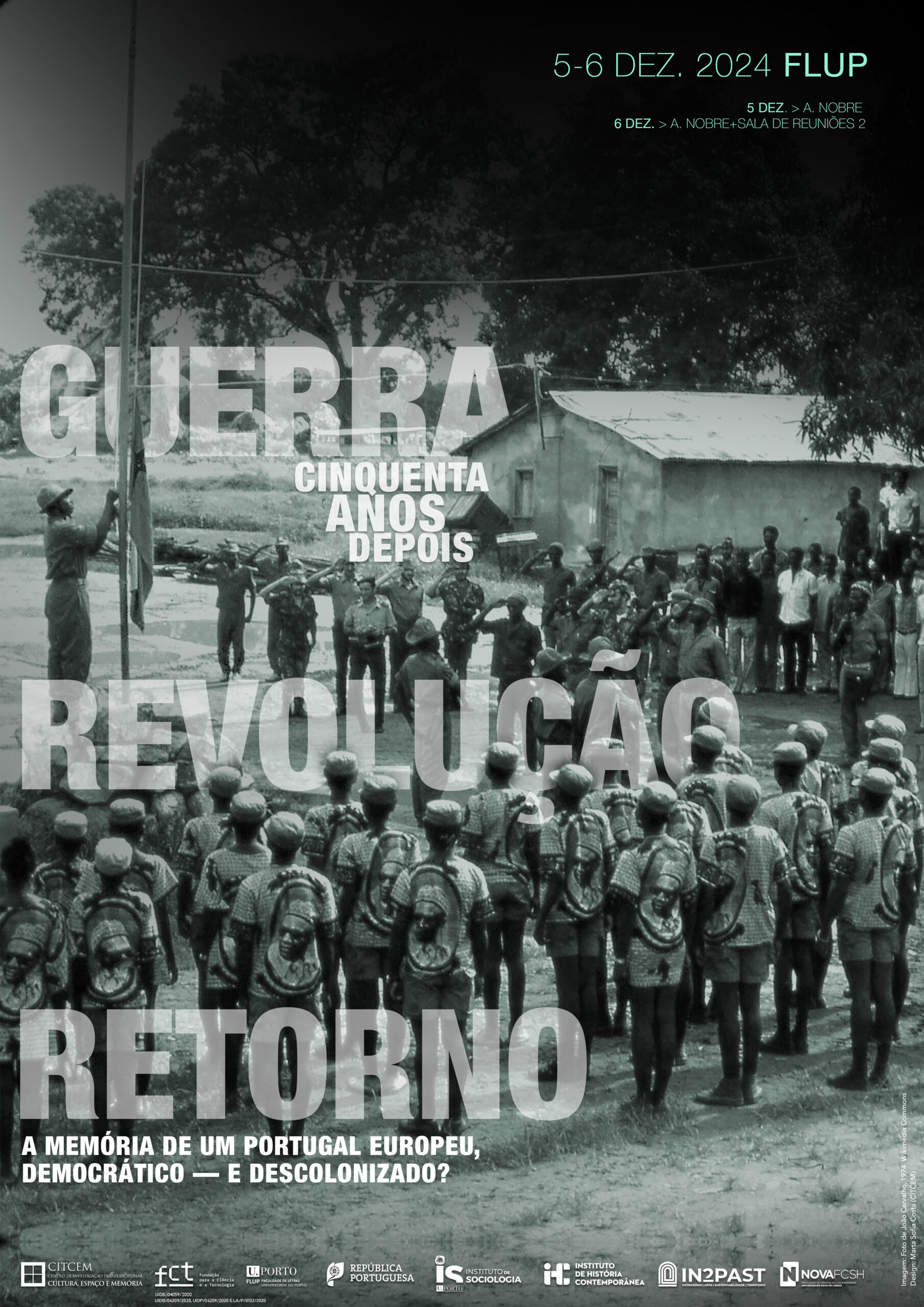
Local:
FLUP
Data início:
05/12/2024
Data fim:
06/12/2024
Horário:
Organização:
CITCEM
Grupo de Investigação Associado
Tipo de Evento:
Congresso
Congresso "Guerra, Revolução e Retorno: 50 anos depois, a memória de um Portugal europeu, democrático - e descolonizado?"
Congresso “Guerra, Revolução e Retorno: 50 anos depois, a memória de um Portugal europeu, democrático – e descolonizado?”
Faculdade de Letras da Universidade do Porto, 5-6 de dezembro
PROGRAMA
5 de Dezembro, quinta-feira.
FLUP: Anfiteatro Nobre
09:30 Abertura
10:00 – 11:15 O fim do Império: dinâmicas internacionais da democracia
Gonçalo Margato (ISCTE-IUL) – Concepções (nada) imaculadas: continuidades coloniais na opção europeia da democracia portuguesa
Gabriela Azevedo (CEPED-UERJ/(IS-UP)/Sandra Silva (UNEB) – Violência e vigilância – redes, sentidos, mudanças e permanências na triangulação lusófona América-África- Europa em ditadura e democracia
Adriana Esteves (Lab2PT/UM)/Bruno Madeira (UM/CITCEM) – De Portugal para o Mundo: os estudantes portugueses e a educação soviética (1976-1995)
11:30 – 12:45 Os combatentes da Guerra Colonial, ontem e hoje
Carolina Ribeiro (FLUP) – O que resta da Guerra Colonial: Os traços urbanos e o processo de construção de identidade dos ex-combatentes
Daniel Filipe Soares da Silva (FLUP) – Na fronteira do esquecimento – a memória dos combatentes da Guerra Colonial Portuguesa
Luís Grosso Correia (CIIE/FLUP) – “Lágrimas de guerra” do alferes, oposicionista e advogado Mário Brochado Coelho (1963-1974)
12:45 – 13:45 Almoço
13:45 – 14:45 Keynote: Julião Soares Sousa (CEIS20/UC) – Guerras, revolução e descolonizações: velhas narrativas e novos olhares a partir de uma perspetiva pós-colonial
15:00 – 16:15 Narrativas coloniais e ditatoriais portuguesas
Cybelle Mendes (UFRGS/LAPPACS) – Fome, medo e memória coletiva – Narrativas audiovisuais (de)coloniais e democráticas
Libânia Pinto (Lab2PT/UM)/Fátima Moura Ferreira (Lab2PT/UM) – Dominação colonial através do olhar: análise das narrativas visuais a partir das fotografias da Companhia de Diamantes de Angola (Diamang), 1960-1969
Luísa Veloso (ISCTE/CIES) e Cláudia Dias – DES: memórias, desmemórias e rememórias vertidas em palco
16:30 – 17:45 Descolonização e rememoração
João Paulo Avelãs Nunes – Portugal hoje e a memória sobre a segunda metade do século XX. A função da historiografia e de tecnologias de base científica também dela derivadas
Amanda Oiza Bucknor (STSGU/ISCTE) – Who’s Story? – a perspective on transformation of colonial narratives in lisbons urban space
Lígia Ferro (IS-UP/FLUP), Beatriz Lacerda (IS-UP/FLUP), Lydia Matthews (The New School EUA), Susan Meseilas (Magnum Photos-EUA) – Travessia nas ruas do Porto: Um projeto colaborativo para descolonizar a cidade
18:00 – 19:00 Apresentação Livro 25 de Abril. Revolução e mudança em 50 anos de memória de Manuel Loff (IN2PAST/FLUP) e Miguel Cardina (CES/UC).
Apresentação: Sílvia Correia e Núcleo Académico de História da Universidade do Porto.
6 de Dezembro, sexta-feira
FLUP: Sala de Reuniões 2
11:00 – 12:15 Nostalgias imperiais, novos e velhos usos
Gil Duarte Ribeiro (FLUP) – Baunilha e Chocolate: nostalgia colonial no Festival RTP da Canção (1964-1998)
Fábio Silva (NOVA FCSH)) – A Memória do Império Colonial: Indígenas e Identidades Híbridas
Afonso Silva (CEDID-UAB/IHC-NOVA FCSH) – Os usos do passado revolucionário na nova extrema-direita nacionalista
12:30 – 13:30 A Fé e o império. A religião perante Abril
Elsa Pereira (IS-UP/FLUP) – (R)evoluções de Fé, pelos Olhos das Mulheres: como a Revolução de Abril e a Queda do Colonialismo influenciaram as práticas religiosas em Portugal e África
Patrícia Freitas (CITCEM/FLUP) – «A África continua a chamar por nós»: a hierarquia católica e a imprensa diocesana no dealbar da Guerra Colonial
13:30 – 14:30 Almoço
14:30 – 16:00 Resistência e Discurso: das guerras de libertação nacional ao pós-independência
Eduardo Esteves (NOVA FCSH) – As últimas eleições do Moçambique colonial (1973): limitações do marcelismo colonial e hierarquias raciais de poder
Libânia Pinto (Lab2PT)/Francisco Azevedo Mendes (Lab2PT/UM) – Os editoriais do Nô Pintcha no processo de construção de memórias oficiais na Guiné-Bissau, 1975-1991.
José Luis Moreno-Perez (U. Sevilha) – La intervención de la CIA y el activismo estudiantil angoleño y mozambiqueño contra el régimen colonial portugués y el Estado Novo en los años sesenta
Neo-Aidan H. O. Allert (U. Cambridge) – Return to the Source: Reclaiming Amílcar Cabral’s Critical Hermeneutics for a Post-Revolutionary, Postcolonial Portugal
FLUP: Anfiteatro 2
09:30 – 10:45 1974 – 1976: o retorno
Estefânia Magalhães (UM)/Bruno Madeira (UM/CITCEM) – O conflito da memória pessoal e da metanarrativa histórica na experiência colonial portuguesa. A vivência de três portugueses nos territórios africanos ocupados, 1955-1976
Fernando Tavares Pimenta (CEHA-Alberto Vieira)/Odete Souto (CEHA-Alberto Vieira) – De África para a Madeira: memórias do “retorno” e do processo de integração dos deslocados da descolonização portuguesa
Bruno Góis (CEEC/FLUL/ICS) – Portugueses retornados e 25 de abril: memória com classe, género e raça
11:00 – 12:15 Memórias de um Portugal europeu
Alice Cunha (IPRI – NOVA FCSH) – Portugal Pós-Imperial e Pró-Europeu: os debates políticos sobre a nova inserção internacional do país em democracia
Pedro Ponte e Sousa (UPT/IPRI) – Redefining Portugal from Empire to Europe: national identity through foreign policy aspirations of elites and decision-makers
Clara Isabel Serrano (CEIS20/UC) – A ponta d’A Jangada de Pedra: a integração europeia nos manuais de História do 9.o ano de escolaridade (1975-2022)
12:30 – 13:30 Verão Quente e Reforma Agrária
Lucas Frucci (Lab2PT/UM), Bruno Madeira (UM/CITCEM), Fátima Moura Ferreira (Lab2PT/UM) – Do “Verão Quente” ao 25 de Novembro de 1975, violência e contrarrevolução em Famalicão: um olhar a partir da imprensa local
João Pedro Soares (ICNOVA/NOVA FCSH) – Ocupações: os campos do Sul e a reforma agrária em “Linha Vermelha” (2011)
13:30 – 14:30 Almoço
14:30 – 16:00 Memória e historiografia – interconexões atlânticas
Carla Ribeiro – O direito à memória: o papel da sociedade civil na valorização da luta dos resistentes ao regime ditatorial do Estado Novo
Isabela Ramos (CITCEM) – Uma narrativa museológica da Guerra de Libertação Nacional: continuidade ou rutura do discurso colonial na identidade nacional portuguesa?
Eduardo Duque/Ana Lima de Assis – Uma expressão do legado e memórias coloniais a partir da diáspora africana ocorrida no Brasil
João Gonçalves – O passado que se quer esquecer: África, Guerra Colonial Portuguesa (1961-1974) e Descolonização na Resenha Histórico-Militar das Campanhas de África (1988-1990)
16:15 – 17:30 Keynote: Elsa Peralta (CEComp) – A Revolução de Abril e o fim do Império: memórias em conflito no Portugal pós-colonial
Comissão Organizadora: Ana Sofia Ferreira (FLUP e IS-UP), Bruno Madeira (UM e CITCEM), Carlos Martins (IUE, Florença), Manuel Loff (FLUP e IHC-NOVA-FCSH/IN2PAST), Sérgio Neto (FLUP e CITCEM), Sílvia Correia (FLUP e IS-UP)
Os 50 anos das últimas transições democráticas da Europa ocidental (Portugal, Espanha e Grécia) cumprem-se num tempo presente caracterizado por uma deriva antidemocrática sem precedentes desde há décadas e pelo questionamento sistemático de alguns dos pressupostos sociais, políticos e económicos que caracterizaram a democracia desde o fim da II Guerra Mundial – entre outros, a consagração efetiva do direito à autodeterminação e da exigência política e moral da descolonização. A discussão pública, com inevitável dimensão política, que presentemente se desenvolve em torno do significado do 25 de Abril de 1974 prova, por um lado, que a passagem do tempo por si só não empresta consensualidade à interpretação das mudanças históricas, e, por
outro, como é permanentemente relevante o debate académico rigoroso, crítico e apoiado num trabalho de reflexão e investigação históricas abrangentes.
Esse debate e essa investigação são ainda mais urgentes considerando que, no momento em que se comemoram 50 anos da Revolução dos Cravos, continuam a imperar narrativas simplistas que informam o debate político no presente, incapazes de uma análise de fundo e de longa duração daquilo que foram, são, e continuarão a ser no futuro, as grandes transformações desencadeadas pelo movimento militar conduzido pelo MFA. Em 2024, muito do debate público continua dependente de motivações comemorativas ou depreciativas, ignorando muito de como o Portugal democrático de hoje foi e é moldado: pela violência da colonização diferente (“lusotropical”); pela violência de 13 anos de Guerra Colonial e suas profundas consequências; por um biénio (1974/1976) de transformações sem precedentes na história contemporânea portuguesa (revolução social, política e económica, e fim da dominação colonial);
por uma descolonização complexa, geradora de novas nações e de regressos; pelo fim, efetivo, de cinco séculos de história imperial; pelo regresso de milhares de retornados, combatentes e os seus processos de (re)integração social e económica; e finalmente pela memória, individual, coletiva, mas também política, uma memória de Abril sempre disputada, do Estado Novo, do colonialismo e da resistência democrática antifascista.
Partindo de uma preocupação em pensar os usos do passado, este congresso propõe-se debater em torno da experiência, representação e rememoração da violência quer do passado colonial em Portugal, quer do processo de descolonização. Assim, procurar-se-á identicamente dar centralidade à Guerra Colonial, questionando o seu significado de rutura ou de continuidade estrutural, e sua interpretação e influência na realidade pós-colonial da ex-metrópole e das ex-colónias. Finalmente pretende-se discutir o lugar da Revolução de Abril nesta história não só como o grande catalisador de mudança, mas também como como consequência direta da violência colonial e como pedra basilar de uma sociedade democrática pós-colonial em permanente tensão com o seu passado.
Linhas Temáticas:
• O colonialismo tardio português dos anos 1960 e 1970, o canto do cisne da “Missão Civilizadora”: desenvolvimento do território e “conquista” das populações;
• A violência como legado: o impacto duradouro da violência colonial no processo político português e africano antes e depois de Abril;
• A relação entre a Guerra Colonial, o fim do Estado Novo e a Revolução dos Cravos;
• 25 de Abril de 1974, de África até ao Carmo: a preponderância africana e do passado colonial nos destinos portugueses;
• Legados e memórias coloniais para a posteridade democrática: ex-combatentes, retornados. (re)integração social económica e política num contexto revolucionário;
• Três dimensões memoriais paralelas: a memória da Guerra, a memória da Revolução, a memória da descolonização;
• As narrativas históricas e políticas do regime democrático português, nomeadamente na sua abordagem ao colonialismo, ao fim do império e ao fim do Estado Novo;
• O fim do império e a Europa: a integração europeia e as novas identidades nacionais;
• Portugal visto de África: a perspetiva das ex-colónias;
• As relações com os países independentes: os legados do colonialismo em Portugal e em África;
Envio de propostas de comunicação:
A organização não cobra inscrições.
Comissão Organizadora: Ana Sofia Ferreira (FLUP e IS-UP), Bruno Madeira (UM e CITCEM), Carlos Martins (IUE, Florença), Manuel Loff (FLUP e IHC-NOVA-FCSH/IN2PAST, Sérgio Neto (FLUP e CITCEM), Sílvia Correia (FLUP e IS-UP)
Congreso “Guerra, Revolución y Retorno: 50 años después, la memoria de un Portugal europeo, democrático – ¿y descolonizado?”
El 50º aniversario de las últimas transiciones democráticas en Europa Occidental (Portugal, España y Grecia) tienen lugar en un momento caracterizado por una deriva antidemocrática sin precedentes desde hace décadas y por el cuestionamiento sistemático de algunos de los supuestos sociales, políticos y económicos que han caracterizado la democracia desde el final de la Segunda Guerra Mundial – entre otros, la consagración efectiva del derecho de autodeterminación y la exigencia política y moral de la descolonización. El debate público, con su inevitable dimensión política, que está teniendo lugar actualmente en torno al significado del 25 de Abril de 1974 demuestra, por un lado, que el paso del tiempo por sí solo no presta consenso a la interpretación de los cambios históricos y, por otro, que el debate académico riguroso y crítico, apoyado en una reflexión y una investigación históricas exhaustivas, está permanentemente de actualidad.
Este debate y la investigación son tanto más urgentes cuanto que, en el momento en que se conmemoran los 50 años de la Revolución de los Claveles, narrativas simplistas siguen informando el debate político, incapaces de un análisis profundo y a largo plazo de lo que fueron, son y seguirán siendo en el futuro las grandes transformaciones desencadenadas por el movimiento militar
liderado por el MFA. En 2024, gran parte del debate público sigue dependiendo de motivaciones en línea con la herencia del 25 de Abril, o, por el contrario, que le son abiertamente hostiles, ignorando en gran medida cómo el Portugal democrático de hoy fue y es moldeado por la violencia de una colonización que se creía diferente (“lusotropical”); por la violencia de 13 años de Guerra Colonial y sus profundas consecuencias; por un bienio (1974/1976) de transformaciones sin precedentes en la historia contemporánea portuguesa (revolución social, política y económica, y fin de la dominación colonial); por una descolonización compleja, generadora de nuevas naciones y de retornos; por el fin efectivo de cinco siglos de historia imperial; por el regreso de miles de retornados, combatientes y por sus procesos de (re)integración social y económica; y, por último, por la memoria, individual, colectiva, pero también política, una memoria siempre disputada de Abril, del Estado Novo, del colonialismo y de la resistencia democrática antifascista.
Partiendo de la reflexión sobre los usos del pasado, este congreso pretende debatir sobre la experiencia, la representación y el recuerdo de la violencia, tanto en el pasado colonial de Portugal como en el proceso de descolonización. También se centrará en la Guerra Colonial, cuestionando su significado como ruptura o continuidad estructural, y su interpretación e influencia en la realidad poscolonial de la antigua metrópoli y de las antiguas colonias. Por último, se busca debatir el lugar de la Revolución de Abril en esta historia, no sólo como gran catalizador del cambio, sino también como consecuencia directa de la violencia colonial y como piedra angular de una sociedad democrática poscolonial en permanente tensión con su pasado.
Líneas Temáticas:
– El tardocolonialismo portugués de los años 60 y 70, canto del cisne de la “Misión Civilizadora”: desarrollo del territorio y “conquista” de las poblaciones;
– La violencia como legado: el impacto duradero de la violencia colonial
en el proceso político portugués y africano antes y después de Abril;
– La relación entre la Guerra Colonial, el fin del Estado Novo y la Revolución de los Claveles;
– 25 de Abril de 1974, de África al Largo do Carmo: la preponderancia de África y del pasado colonial en los destinos portugueses;
– Legados coloniales y memorias para la posteridad democrática: excombatientes, retornados, (re)integración social, económica y política en un contexto revolucionario;
– Tres dimensiones memoriales paralelas: la memoria de la Guerra, la memoria de la Revolución, la memoria de la descolonización;
– Las narrativas históricas y políticas del régimen democrático portugués, especialmente en su aproximación al colonialismo, el fin del imperio y el fin del Estado Novo;
– El fin del imperio y Europa: integración europea y nuevas identidades nacionales;
– Portugal visto desde África: la perspectiva de las antiguas colonias;
– Las relaciones con los países independientes: los legados del colonialismo en Portugal y África;
La organización no cobra por la inscripción.
C
EVENTOS
Eventos: Congresso “Guerra, Revolução e Retorno: 50 anos depois, a memória de um Portugal europeu, democrático – e descolonizado?”
Local:
FLUP
Data início:
05/12/2024
Data fim:
06/12/2024
Horário:
Organização:
CITCEM
Grupo de Investigação Associado
Tipo de Evento:
Congress
Congress "War, Revolution and Return: 50 years on, the memory of a European, democratic - and decolonized - Portugal?"
Congress “War, Revolution and Return: 50 years on, the memory of a European, democratic – and decolonized – Portugal?”
Faculty of Letters of the University of Porto, December 5-6
PROGRAM
December 5th, Thursday.
FLUP: Noble Amphitheater
09:30 Opening
10:00 – 11:15 The end of Empire: international dynamics of democracy
Gonçalo Margato (ISCTE-IUL) – Concepções (nada) immaculadas: continuidades coloniais na opção europeia da democracia portuguesa
Gabriela Azevedo (CEPED-UERJ/(IS-UP)/Sandra Silva (UNEB) – Violence and surveillance – networks, meanings, changes and permanence in the Lusophone America-Africa-Europe triangle in dictatorship and democracy
Adriana Esteves (Lab2PT/UM)/Bruno Madeira (UM/CITCEM) – From Portugal to the world: Portuguese students and Soviet education (1976-1995)
11:30 – 12:45 Colonial War fighters, yesterday and today
Carolina Ribeiro (FLUP) – What remains of the Colonial War: Urban traces and the process of identity construction of ex-combatants
Daniel Filipe Soares da Silva (FLUP) – On the border of oblivion – the memory of Portuguese Colonial War combatants
Luís Grosso Correia (CIIE/FLUP) – “Tears of war” by ensign, oppositionist and lawyer Mário Brochado Coelho (1963-1974)
12:45 – 13:45 Lunch
13:45 – 14:45 Keynote: Julião Soares Sousa (CEIS20/UC) – Wars, revolution and decolonization: old narratives and new perspectives from a postcolonial perspective
15:00 – 16:15 Portuguese colonial and dictatorial narratives
Cybelle Mendes (UFRGS/LAPPACS) – Hunger, fear and collective memory – (de)colonial and democratic audiovisual narratives
Libânia Pinto (Lab2PT/UM)/Fátima Moura Ferreira (Lab2PT/UM) – Colonial domination through the gaze: analysis of visual narratives based on photographs of the Angola Diamond Company (Diamang), 1960-1969
Luísa Veloso (ISCTE/CIES) and Cláudia Dias – DES: memories, dememories and rememories on stage
16:30 – 17:45 Decolonization and remembrance
João Paulo Avelãs Nunes – Portugal today and the memory of the second half of the 20th century. The role of historiography and science-based technologies derived from it
Amanda Oiza Bucknor (STSGU/ISCTE) – Who’s Story? – a perspective on transformation of colonial narratives in lisbons urban space
Lígia Ferro (IS-UP/FLUP), Beatriz Lacerda (IS-UP/FLUP), Lydia Matthews (The New School USA), Susan Meseilas (Magnum Photos-USA) – Crossing the streets of Porto: A collaborative project to decolonize the city
18:00 – 19:00 Presentation of the book 25 de Abril. Revolution and change in 50 years of memory Manuel Loff (IN2PAST/FLUP) and Miguel Cardina (CES/UC).
Presentation: Sílvia Correia and Núcleo Académico de História da Universidade do Porto.
December 6th, Friday
FLUP: Meeting Room 2
11:00 – 12:15 Imperial nostalgias, new and old uses
Gil Duarte Ribeiro (FLUP) – Vanilla and Chocolate: colonial nostalgia in the RTP Song Festival (1964-1998)
Fábio Silva (NOVA FCSH)) – The Memory of the Colonial Empire: Indigenous and Hybrid Identities
Afonso Silva (CEDID-UAB/IHC-NOVA FCSH) – The uses of the revolutionary past in the new nationalist far right
12:30 – 13:30 Faith and empire. Religion in the face of April
Elsa Pereira (IS-UP/FLUP) – (R)evolutions of Faith, through the Eyes of Women: how the April Revolution and the Fall of Colonialism influenced religious practices in Portugal and Africa
Patrícia Freitas (CITCEM/FLUP) – “Africa continues to call for us”: the Catholic hierarchy and the diocesan press at the dawn of the Colonial War
13:30 – 14:30 Lunch
14:30 – 16:00 Resistance and Discourse: from the wars of national liberation to post-independence
Eduardo Esteves (NOVA FCSH) – The last elections in colonial Mozambique (1973): limitations of colonial Marcelism and racial hierarchies of power
Libânia Pinto (Lab2PT)/Francisco Azevedo Mendes (Lab2PT/UM) – The editorials of Nô Pintcha in the process of constructing official memories in Guinea-Bissau, 1975-1991.
José Luis Moreno-Perez (U. Sevilla) – CIA intervention and student activism in Angola and Mozambique against the Portuguese colonial regime and the Estado Novo in the 1960s
Neo-Aidan H. O. Allert (U. Cambridge) – Return to the Source: Reclaiming Amílcar Cabral’s Critical Hermeneutics for a Post-Revolutionary, Postcolonial Portugal
FLUP: Amphitheater 2
09:30 – 10:45 1974 – 1976: the comeback
Estefânia Magalhães (UM)/Bruno Madeira (UM/CITCEM) – The conflict between personal memory and historical metanarrative in the Portuguese colonial experience. The experience of three Portuguese in occupied African territories, 1955-1976
Fernando Tavares Pimenta (CEHA-Alberto Vieira)/Odete Souto (CEHA-Alberto Vieira) – From Africa to Madeira: memories of the “return” and the process of integration of displaced people from Portuguese decolonization
Bruno Góis (CEEC/FLUL/ICS) – Portuguese returnees and April 25: memory with class, gender and race
11:00 – 12:15 Memories of a European Portugal
Alice Cunha (IPRI – NOVA FCSH) – Portugal Post-Imperial and Pro-European: the political debates on the country’s new international insertion in democracy
Pedro Ponte e Sousa (UPT/IPRI) – Redefining Portugal from Empire to Europe: national identity through foreign policy aspirations of elites and decision-makers
Clara Isabel Serrano (CEIS20/UC) – The tip of The Stone Raft: European integration in 9th grade history textbooks (1975-2022)
12:30 – 13:30 Hot Summer and Agrarian Reform
Lucas Frucci (Lab2PT/UM), Bruno Madeira (UM/CITCEM), Fátima Moura Ferreira (Lab2PT/UM) – From the “Hot Summer” to November 25, 1975, violence and counter-revolution in Famalicão: a look at the local press
João Pedro Soares (ICNOVA/NOVA FCSH) – Occupations: the fields of the South and agrarian reform in “Red Line” (2011)
13:30 – 14:30 Lunch
14:30 – 16:00 Memory and historiography – Atlantic interconnections
Carla Ribeiro – The right to memory: the role of civil society in highlighting the struggle of those who resisted the dictatorial regime of the Estado Novo
Isabela Ramos (CITCEM) – A museological narrative of the National Liberation War: continuity or rupture of the colonial discourse in Portuguese national identity?
Eduardo Duque/Ana Lima de Assis – An expression of the colonial legacy and memories from the African diaspora in Brazil
João Gonçalves – O passado que se quer esquecer: África, Guerra Colonial Portuguesa (1961-1974) e Descolonização na Resenha Histórico-Militar das Campanhas de África (1988-1990)
16:15 – 17:30 Keynote: Elsa Peralta (CEComp) – The April Revolution and the end of the Empire: conflicting memories in post-colonial Portugal
Organizing Committee: Ana Sofia Ferreira (FLUP and IS-UP), Bruno Madeira (UM and CITCEM), Carlos Martins (IUE, Florence), Manuel Loff (FLUP and IHC-NOVA-FCSH/IN2PAST), Sérgio Neto (FLUP and CITCEM), Sílvia Correia (FLUP and IS-UP)
The 50th anniversary of the last democratic transitions in Western Europe (Portugal, Spain and Greece) is taking place at a time characterized by an anti-democratic drift that has been unprecedented for decades and by the systematic questioning of some of the social, political and economic assumptions that have characterized democracy since the end of World War II – among others, the effective enshrinement of the right to self-determination and the political and moral demand for decolonization.
The public discussion, with its inevitable political dimension, that is currently taking place around the meaning of April 25, 1974 proves, on the one hand, that the passage of time alone does not lend consensus to the interpretation of historical changes, and, on the other, that rigorous, critical academic debate supported by comprehensive historical reflection and research is permanently relevant. This debate and research is all the more urgent given that, at a time when the 50th anniversary of the Carnation Revolution is being commemorated, simplistic narratives continue to inform the political debate in the present, incapable of an in-depth, long-term analysis of what the great transformations triggered by the military movement led by the MFA were, are and will continue to be in the future. In 2024, much of the public debate remains dependent on commemorative or derogatory motivations, ignoring much of how today’s democratic Portugal was and is shaped: by the violence of a different (“lusotropical”) colonization; by the violence of 13 years of Colonial War and its profound consequences; by a two-year period (1974/1976) of unprecedented transformations in contemporary Portuguese history (social, political and economic revolution, and the end of colonial domination); by a complex decolonization, generating new nations and returns; by the effective end of five centuries of imperial history; by the return of thousands of returnees, combatants and their processes of social and economic (re)integration; and finally by the memory, individual, collective, but also political, an always disputed memory of April, of the Estado Novo, colonialism and anti-fascist democratic resistance. Based on a concern to think about the uses of the past, this congress proposes to debate the experience, representation and remembrance of violence, both in Portugal’s colonial past and in the process of decolonization. It will also focus on the Colonial War, questioning its significance as a rupture or structural continuity, and its interpretation and influence on the post-colonial reality of the former metropolis and the former colonies. Finally, the aim is to discuss the place of the April Revolution in this history, not only as the great catalyst for change, but also as a direct consequence of colonial violence and as the cornerstone of a post-colonial democratic society in permanent tension with its past. Thematic Lines: – Portuguese late colonialism in the 1960s and 1970s, the swan song of the “Civilizing Mission”: development of the territory and “conquest” of the populations; – Violence as a legacy: the lasting impact of colonial violence on the Portuguese and African political process before and after April; – The relationship between the Colonial War, the end of the Estado Novo and the Carnation Revolution; – April 25, 1974, from Africa to Carmo: the preponderance of Africa and the colonial past in Portuguese destinies; – Colonial legacies and memories for democratic posterity: ex-combatants, returnees.
Social, economic and political (re)integration in a revolutionary context; – Three parallel memorial dimensions: the memory of the War, the memory of the Revolution, the memory of decolonization; – The historical and political narratives of the Portuguese democratic regime, particularly its approach to colonialism, the end of the empire and the end of the Estado Novo; – The end of the empire and Europe: European integration and new national identities; – Portugal seen from Africa: the perspective of the former colonies; – Relations with independent countries: the legacies of colonialism in Portugal and Africa; Submission of paper proposals: The organization does not charge for registration.
Organizing Committee: Ana Sofia Ferreira (FLUP and IS-UP), Bruno Madeira (UM and CITCEM), Carlos Martins (IUE, Florence), Manuel Loff (FLUP and IHC-NOVA-FCSH/IN2PAST, Sérgio Neto (FLUP and CITCEM), Sílvia Correia (FLUP and IS-UP)
Congress “War, Revolution and Return: 50 years later, the memory of a European, democratic – and decolonized – Portugal?”
The 50th anniversary of the last democratic transitions in Western Europe (Portugal, Spain and Greece) is taking place at a time characterized by an anti-democratic drift that has been unprecedented for decades and by the systematic questioning of some of the social, political and economic assumptions that have characterized democracy since the end of the Second World War – among others, the effective consecration of the right to self-determination and the political and moral demand for decolonization. The public debate, with its inevitable political dimension, that is currently taking place around the meaning of April 25, 1974 demonstrates, on the one hand, that the passage of time alone does not lend consensus to the interpretation of historical changes and, on the other hand, that the rigorous and critical academic debate, supported by exhaustive historical reflection and research, is permanently up-to-date. This debate and research are all the more urgent since, at a time when the 50th anniversary of the Claveles Revolution is being commemorated, simplistic narratives continue to inform the political debate, incapable of a deep and long-term analysis of what the great transformations triggered by the military movement
led by the MFA will continue to be in the future. In 2024, a large part of the public debate continues to depend on motivations that are in line with the heritage of 25 April, or, on the contrary, that are openly hostile to it, largely ignoring how today’s democratic Portugal was and is shaped by the violence of a colonization that was believed to be different (“lusotropical”); by the violence of 13 years of Colonial War and its profound consequences; by a period (1974/1976) of unprecedented transformations in contemporary Portuguese history (social, political and economic revolution, and the end of colonial rule); for a complex decolonization, generating new nations and returns; for the effective end of five centuries of imperial history; for the return of thousands of returnees, combatants and their processes of social and economic (re)integration; and, finally, for the memory, individual, collective, but also political, an always disputed memory of April, the Estado Novo, colonialism and anti-fascist democratic resistance. Starting from a reflection on the uses of the past, this congress aims to discuss the experience, representation and memory of violence, both in Portugal’s colonial past and in the process of decolonization. It will also focus on the Colonial War, questioning its meaning as a rupture or structural continuity, and its interpretation and influence on the post-colonial reality of the former metropolis and former colonies. Finally, the aim is to discuss the place of the April Revolution in this history, not only as a major catalyst for change, but also as a direct consequence of colonial violence and as the cornerstone of a post-colonial democratic society in permanent tension with its past.
Thematic Lines: – Portuguese colonialism in the 1960s and 1970s, the swan song of the “Civilizing Mission”: territorial development and the “conquest” of populations; – Violence as a legacy: el impacto duradero de la violencia colonial
en el proceso político portugués y africano antes y después de Abril; – La relación entre la Guerra Colonial, el fin del Estado Novo y la Revolución de los Claveles; – 25 de Abril de 1974, de África al Largo do Carmo: la preponderancia de África y del pasado colonial en los destinos portugueses; – Legados coloniales y memorias para la posteridad democrática: excombatientes, retornados, (re)integración social, económica y política en un contexto revolucionario; – Tres dimensiones memoriales paralelas: la memoria de la Guerra, la memoria de la Revolución, la memoria de la descolonización; – Las narrativas históricas y políticas del régimen democrático portugués, especialmente en su aproximación al colonialismo, el fin del imperio y el fin del Estado Novo; – El fin del imperio y Europa: European integration and new national identities; – Portugal seen from Africa: the perspective of the former colonies; – Relations with the independent countries: the legacies of colonialism in Portugal and Africa;
The organization does not charge for registration.
C